Kernel-enforced credential and network jail for untrusted Linux processes — AI coding agents are the canonical use case.




Warning
Disclaimer. This sandbox is a best-effort, user-space isolation layer. It is not a security product and comes with no guarantees. It reduces the attack surface of AI coding agents on shared systems, but it cannot prevent all possible bypasses — see the Security model for documented limitations. Use at your own risk.
Hides SSH keys, cloud credentials, GPG keys, and environment secrets from any process started inside the jail. Backed by bubblewrap (with firejail and Landlock as fallbacks), six built-in agent profiles (Claude Code, Codex, Gemini, Aider, OpenCode, pi-mono) with a one-line recipe for adding more, zero containers. The shipped profiles and defaults are tuned for AI coding agents on HPC login nodes; the same jail wraps any other command — untrusted CLI tools, local CI / build steps, notebook kernels, or a collaborator's branch checked out for review.
The agent-sandboxing field has converged into roughly six isolation layers — kernel-bind wrappers, OCI containers, gVisor, microVMs, WASM, and hosted SaaS. agent-sandbox sits in the small cluster of process-level kernel-bind wrappers (alongside Anthropic's sandbox-runtime, OpenAI Codex CLI's Linux sandbox, nono, cco, and scode) and is the only project surveyed with first-class HPC/Slurm awareness: the chaperon proxy mediates sbatch, srun, squeue, scancel, scontrol, sacct, and sacctmgr so submissions made from inside the sandbox stay sandboxed on the compute node, with no path for an agent to escape via job submission.
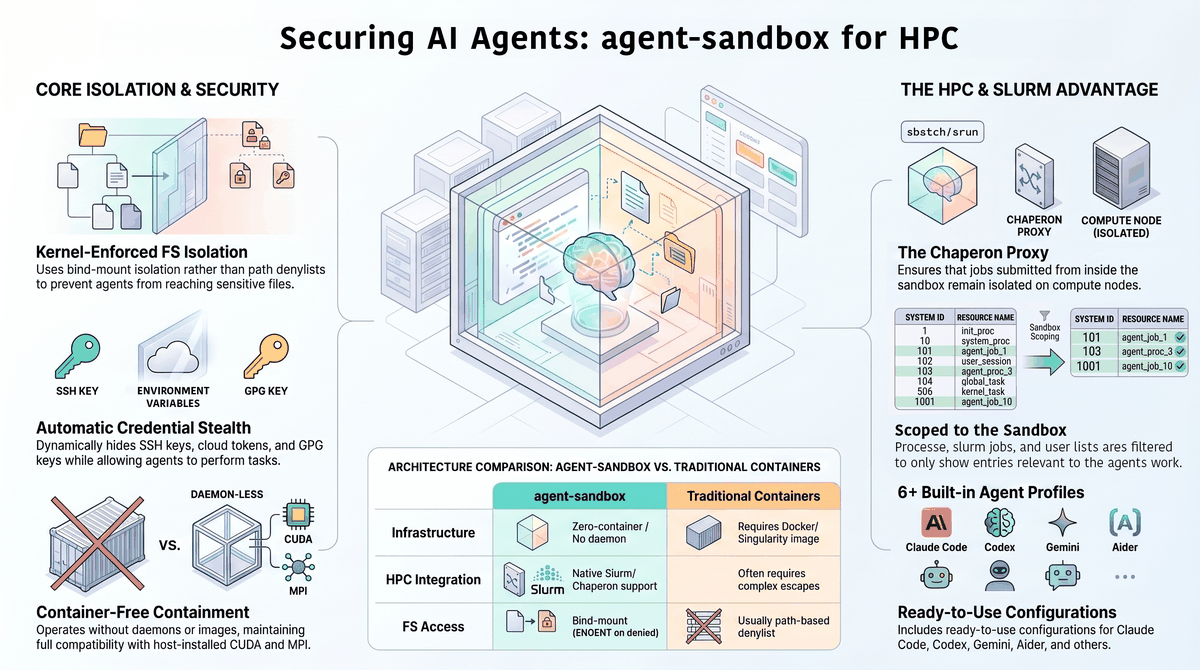
Two structural strengths follow from the design:
- Kernel-enforced bind-mount FS isolation rather than a path-denylist — denied paths return
ENOENT, with no canonical name for an agent to reach viald-linuxor/proc/self/root. Whole evasion classes documented for denylist sandboxes do not apply. - Containment without a container — no image to build, no daemon, no setuid helper on the bwrap backend;
lmod, conda envs, CUDA, MPI, and your installed compiled software work as on the host.
For the field overview, the comparison matrix against six deeply-compared peers, and an honest accounting of where the project lags the field (egress allowlists, credential proxies), see agent-sandbox in the agent-sandboxing landscape.
brew tap katosh/tools
brew install agent-sandbox

agent-sandbox claude          # Claude Code, sandboxed
agent-sandbox bash            # interactive shell, sandboxed
The agent starts in your project directory with read access to the system but write access only there. SSH keys, sensitive tokens, and unrelated credentials are invisible.
Tip
Configure the sandbox. Mounts, devices, environment variables, Slurm scope, and admin enforcement: see the configuration reference.
- Docs: https://katosh.github.io/agent_sandbox/
- Source: https://github.com/katosh/agent_sandbox
- Issues / discussion: https://github.com/katosh/agent_sandbox/issues
- Changelog:
CHANGELOG.md - License: MIT — see
LICENSE